Study English in Dublin
Public Transport in Dublin
Dublin Bus
The most widely used and extensive form of public transport in Dublin is the bus network. Dublin’s regular buses are double-deckers, typically coloured yellow, light blue and dark blue. The destination is displayed prominently at the front of the bus, along with the bus route number.
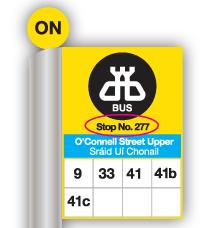
The bus network is largely organised around routes running north to south and vice versa, many of which pass through the city centre. Dublin is divided by the River Liffey, which flows from west to east through the heart of the city. Many of the main bus stops serving the city centre are located along both sides of the river, as well as on O’Connell Street, one of the city’s central thoroughfares.
You can pay your fare directly on the bus, but you must have the exact amount in coins, as notes are not accepted and no change is given. Usually, if you tell the driver the name of the street where you wish to get off, they will tell you the correct fare to pay into the ticket machine. The fare depends on the number of stops, or the distance you intend to travel. To avoid having to carry coins, you can purchase a Leap Card. These cards can be bought from authorised retailers for €5 (the cost of the card itself, excluding travel credit) and then topped up with the amount you need. You can request a card and load it with €10, €20 or more, depending on your travel requirements. As a general guide, a bus journey covering 4–13 stops costs €2.05, while journeys involving more than 13 stops cost €2.60.
Another, perhaps simpler and quicker, way to travel by bus is to purchase a multi-journey ticket or travel pass. International students are often advised to consider the Leap Visitor Card, which allows unlimited travel not only on Dublin’s regular bus services but also on the DART and Luas, the city’s rail and tram networks respectively.
Leap Visitor Cards are available for 1, 2, 3 or 4 weeks and can be purchased at the central Dublin Bus office at 59 Upper O’Connell Street or at Dublin Airport in the arrivals hall.
Other options include monthly and annual passes, as well as the “Rambler” ticket, which offers unlimited travel for 5 or 30 days of use, not necessarily consecutive. The latter can be particularly cost-effective if you use at least two different buses per day. For the latest information on fares, ticket options and routes, visit the Dublin Bus website. We also recommend downloading the Dublin Bus app, which provides real-time bus timetables and route information, including how many minutes remain before your next bus arrives at your stop.
Bus services generally operate from 6:00 am to 11:30 pm daily. Frequencies vary depending on the day and time, with waiting times typically ranging from 5–10 minutes during peak periods to 20–25 minutes on public holidays.
Finally, remember that passengers are expected to queue at bus stops. You should signal to the driver that you wish to board by raising your arm as the bus approaches. Passengers with a Leap Visitor Card, travel pass or Rambler ticket can board and tap their card on the reader immediately to the right, waiting for the confirmation beep. Passengers paying with coins or using a standard Leap Card should approach the driver on the left-hand side to pay for their journey
Luas
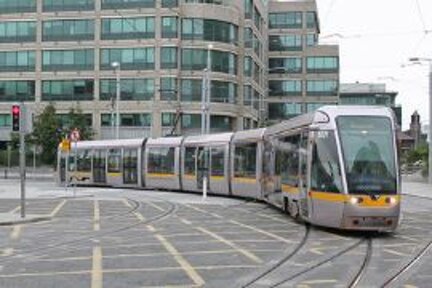
The Luas is Dublin’s light rail tram system.
Dublin has two tram lines: the Red Line and the Green Line. The Red Line connects Tallaght with The Point and Saggart with Connolly Station, with a total of 32 stops and an end-to-end journey time of approximately 53 minutes. The Green Line connects Brides Glen to St Stephen’s Green, with 22 stops and a journey time of around 40 minutes.
The two lines are not directly connected, but tickets purchased for one line can also be used on the other and are valid for the entire journey. St Stephen’s Green, the terminus of the Green Line, is approximately a 15-minute walk from Abbey Street, the nearest Red Line stop.
Luas tram frequencies vary according to the day and time, ranging from approximately 3.5 minutes during peak periods to 15 minutes on public holidays. You must have a valid ticket before boarding the tram. You can also use a Leap Card on the Luas. Tickets are available from vending machines at all stops and from retailers displaying the “Luas Ticket Agents” sign. For information about ticket outlets, fares and services, visit the Luas website or consult the information boards at tram stops.
The Luas generally operates from 5:30 am to 12:30 am, Monday to Friday; from 6:30 am to 12:30 am on Saturdays; and from 7:00 am to 11:30 pm on Sundays and public holidays. For passenger safety, CCTV cameras are installed on all trams and at stops.
Dart
The DART (Dublin Area Rapid Transit) is an excellent way for visitors to explore the areas just beyond Dublin city centre. The green electric trains are not only a convenient way for commuters to travel between the suburbs and the city centre, but also offer tourists the opportunity to discover charming seaside towns along Dublin Bay.
The DART runs along the coast from Howth in the north of the bay to Bray, south of the capital. It is a hybrid between a metro and a commuter railway, running on ground-level or elevated tracks. It is convenient, fast and generally reliable.
Trains run frequently during peak hours and connect with many bus services. The main central stations include Connolly Station, north of the River Liffey, and Tara Street and Pearse Station to the south. There may also be a DART station close to your accommodation.